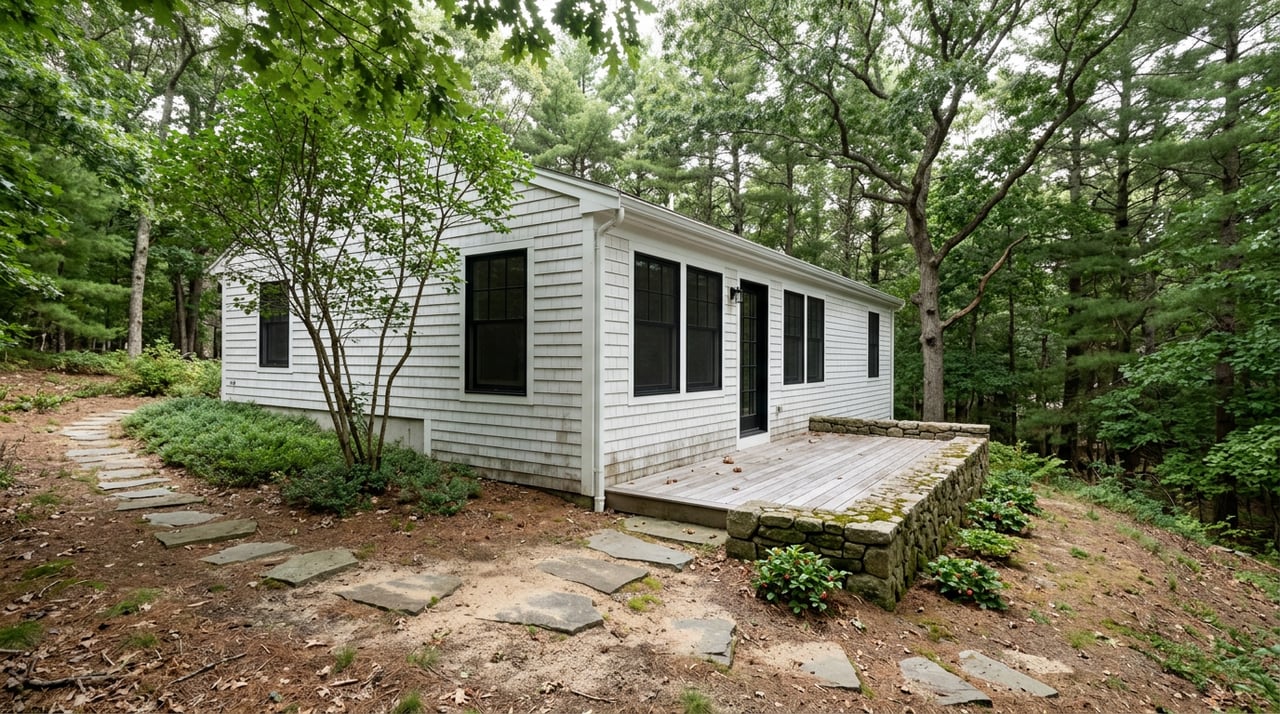
What "No Property Taxes for 50 Years" Actually Means on a Beverly Shores Listing
August 27, 2026
August 27, 2026
Scroll through active listings in Beverly Shores long enough and you will eventually hit a line that stops you cold: no property taxes for the next 50 years for whoever takes over this lease. Read quickly, it sounds like a loophole. Read carefully, it is the opposite of one. It is a countdown clock on a piece of land that will, at the end of that lease, stop being yours and start being part of Indiana Dunes National Park.
This is not a marketing gimmick or a rare legal footnote buried in one eccentric listing. It is the direct result of a decision the federal government made about this town in the 1970s, and it still shapes what a handful of Beverly Shores properties actually are today. If you are seriously considering a purchase here, understanding this mechanism matters more than any square footage number in the listing.
Beverly Shores started as a resort community. Chicago developer Frederick H. Bartlett bought more than 3,000 acres along this stretch of Lake Michigan shoreline in 1927 and platted it for weekend homes reachable by train from the city. That resort identity is still visible in the town's older cottages and its South Shore Line depot.
What changed the town's trajectory came decades later. After the Indiana Dunes National Lakeshore was established in 1966, environmental pressure to protect the surrounding wetlands and dunes intensified. By the 1970s, there was a real push to buy every home in Beverly Shores and fold the entire town into the National Lakeshore. That effort did not fully succeed, but it did not fail either. Many properties, especially those in the wetlands making up the town's southern portion, were acquired outright. Owners of beachfront lots were offered a different deal: a lifetime leaseback, meaning they could keep living in their homes, but the land would revert to the National Lakeshore once the lease ended. A number of those houses have since been demolished as the leases expired.
That acquisition process never actually stopped. It is still running today, which is why a 2026 listing can carry 1970s-era language about reversion.
The clearest way to see how this plays out is to look at what happened to the three Lustron houses the park acquired during this process. All three had different outcomes, and each one tells you something different about what a leaseback can mean in practice.
The Jacob Klien house sat in an ecologically sensitive area and was physically moved to Drake Avenue, where it now sits atop a dune overlooking the lake, preserved and repositioned rather than lost. The Schulof house, originally on Lakefront Drive, was handed over to the Historic Landmarks Foundation of Indiana and relocated to Stephens Street in nearby Porter, where it continues as a preserved structure outside the park's boundary entirely. The Powell house had the least fortunate ending. It still stands on Lakefront Drive, but it now sits inside the park itself and is inaccessible.
Preserved and repositioned. Preserved and removed to a new town. Absorbed and shut off from use. Three different results from the same underlying acquisition mechanism, and none of them are things a buyer would guess just from reading a standard listing sheet.
If a Beverly Shores listing mentions a lease, a reversion clause, or an unusually low or absent tax bill, treat that as a flag to slow down, not a reason to move faster. Before you get attached to a property with this kind of arrangement, you want clear answers to a few specific questions:
None of this is something a listing description will spell out in full, and none of it is something a standard home inspection touches. This is title company and real estate attorney territory, and it is worth paying for that review before you get emotionally invested in a house you may not be able to keep, sell, or pass on the way you would with a conventional fee-simple purchase elsewhere on the lakeshore.
There is a second, related reason Beverly Shores numbers deserve more scrutiny than a quick portal search gives them. This is a town of roughly 600 residents with an unusually small number of homes changing hands in any given year, somewhere around 20 sales across a full twelve-month stretch based on recent tracking. In a market that thin, a single unusual sale can swing the entire median.
You can see this play out if you compare what different trackers reported for Beverly Shores over roughly the same window. One national portal's automated pricing tool showed a median list price of $1.28 million in August 2026, up 79 percent year over year, alongside a typical 110 days on market. Separate tracking of actual closed sales over the trailing twelve months into mid-2026 put the median closer to $1.09 million. Other estimates for the town from mid-2025 landed anywhere from the high $500,000s to just under $1 million, depending on whether the figure represented an automated home value estimate, an asking price, or an actual closed sale.
Those are not small discrepancies, and they are not really contradictions either. They are what happens when you calculate a median from twenty or fewer transactions a year in a town where lot sizes, lake proximity, and now leasehold status all vary enormously from one property to the next. A single dune-top estate sale can pull the median up by six figures. A single fixer-upper sale can pull it back down just as fast. In May 2025, for example, a four-bedroom home with Lake Michigan views that had stayed in the same family for six decades came on the market at $1.1 million, according to Crain's Chicago Business. One listing like that, in a market this size, moves every average calculated afterward.
None of this means the numbers are wrong. It means they are describing a market too small and too structurally varied for a single median to tell you much of anything useful.
The acquisition story here is not finished, and the price story is not settled either. The town's own comprehensive plan, updated as recently as January 2026, continues to track land protection efforts alongside its separate Green Space Initiative, a town-led program that has more than doubled its protected parcel count since 2019, adding 23 lots for a total of 43 as of its most recent Bird Town certification review. That is a different track than the National Park Service leaseback program, but it tells you the same broader thing: land use pressure in Beverly Shores did not end in the 1970s, and it is not ending now.
If you are looking at a specific listing here, the smartest move is treating the price and the property description as a starting point for questions, not a finished answer. Ask what the underlying land status actually is. Ask how the seller's agent is calculating comparable sales in a town where comparables are genuinely scarce. Ask whether the number you saw on a portal reflects an asking price, a closed sale, or an algorithm's best guess.
Does every Beverly Shores property have a lease or reversion clause? No. Most homes here are conventional fee-simple ownership. The leaseback arrangement applies to a specific subset of properties tied to the park's historical acquisition program, mainly along the beachfront and in the wetland areas the National Lakeshore targeted decades ago.
How would I even know if a listing has this kind of clause? It is not always obvious from a portal search. Some listings state it directly, as in the example above. Others require pulling the actual deed or asking the listing agent point blank. This is exactly the kind of detail worth confirming before you tour, not after you fall for a house.
Does a leaseback affect resale value? It can, significantly, depending on how many years remain and how the lease terms are structured. That is a conversation for a title professional and an appraiser familiar with this specific arrangement, not something to estimate from a listing sheet.
Beverly Shores rewards buyers who ask more questions than the portal answers provide. If you are weighing a purchase here, or wondering what your own property is actually worth given how unusual this market's comparables can be, Meghan Maddox can walk through the specifics with you. Request a Free Home Valuation and get a read on your situation that accounts for what makes this lakeshore different, not just what a national algorithm assumes about it.
I am committed to guiding you every step of the way—whether you're buying a home, selling a property, or securing a mortgage. Whatever your needs, I've got you covered.
ADDRESS
1401 LAKE SHORE DR
MICHIGAN CITY IN 46360